VectorMeals
Facts at a glance
The problem
Meal planning is one of the last household systems still run on memory, stress, and improvisation — decided at the worst hour of the day by the most tired person in the house. Most meal planners make it worse in the same way: a stack of unrelated recipes, "serves 4" portions that assume everyone eats the same plate, leftovers left to chance, and a grocery list twice as long as it should be. The result is decision fatigue, food waste, and money leaking out of the household every week.
What VectorMeals is
Not a recipe generator. Not a macro tracker. Not "AI meal suggestions." VectorMeals is a household food coordination system: it treats a household as a set of distinct individuals, plans the week so meals cooperate (one prep session flows into several later meals as different dishes), keeps the grocery list coherent, and adapts to the family's real schedule — busy nights, takeout nights, date nights. The recipes are the implementation layer; the coordination is the product.
The planning engine is deterministic — the same inputs produce the same plan, and every choice is explainable. AI does two small, contained jobs: reading recipes a user pastes in, and writing a plain-English weekly briefing. The founder built the product solo with AI as his development toolchain; the planner itself is not a chatbot.
Three claims we can stand behind
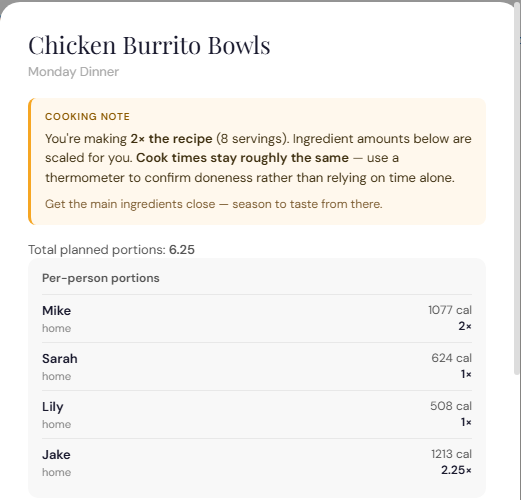
- Portions scaled to the actual household. A teenager and a seven-year-old do not get the same plate. Every recipe is scaled to the individuals at the table — not an arbitrary "serves 4."
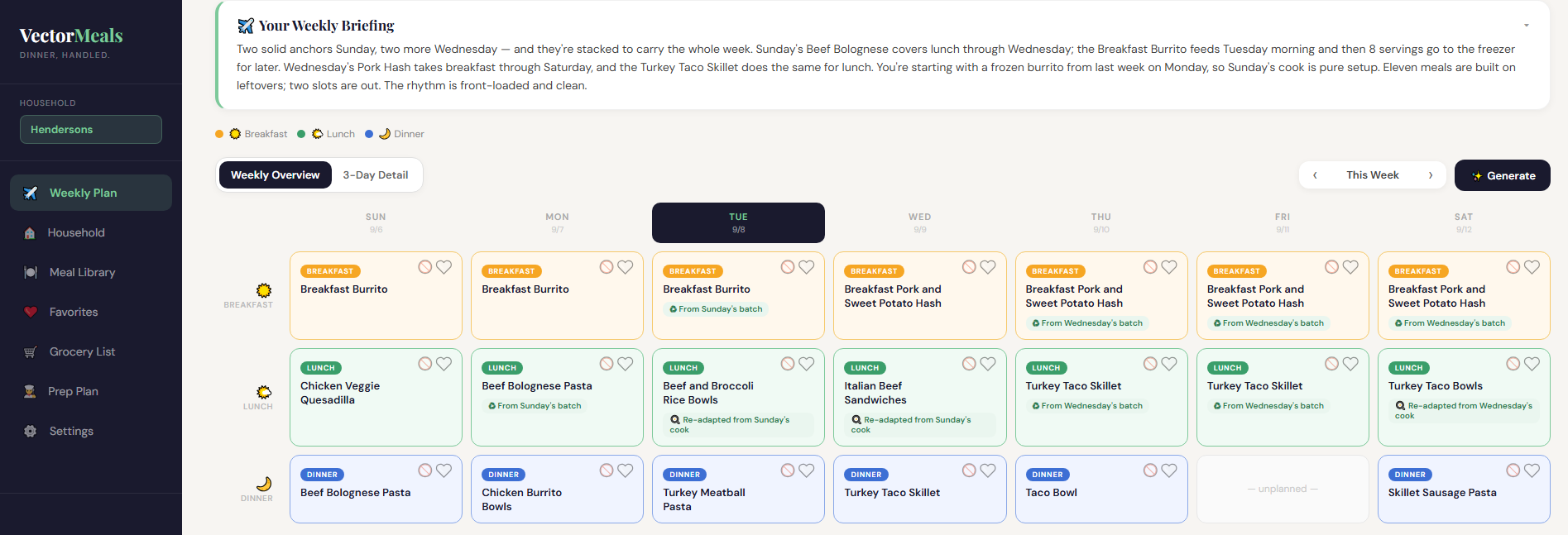
- One cook, several meals, less waste. Intentional carryover routes a single cook session into different meals across the week — Sunday's beef becomes Tuesday's bowls and Wednesday's tacos — cutting cook sessions and waste without eating the same thing every night.
- Measured, published savings. In a modeled study of three households over four consecutive weeks (48 priced scenario-weeks) at real grocery prices (Walmart and Whole Foods, Naperville IL), a planned home-cooked week cost 14–46% less than a blended takeout/home week and 33–76% less than a takeout-heavy week. Even the study's smallest saving — a single adult at Whole Foods — was $32 a week, roughly 14× the subscription; a family of four at Walmart saved $139 a week. The honest finding, stated in the study itself: the dollar savings come from cooking at home at all; VectorMeals' distinct contribution is the coordination and the time back. Full method, results tables, and limitations: vectormeals.com/methodology.
What it is not
- Not another AI recipe app — AI is a small tool inside it, not the product.
- Not a diet or bodybuilding tool — the meals are ordinary family comfort food.
- Not a single-store delivery funnel — shop wherever you like.
Screenshots
Real plan, real household (names changed). Right-click to save; higher-resolution files on request.
Founder
Dan Shafron spent twelve years designing earthmoving equipment at Caterpillar, then a decade running operational systems in commercial real estate — a career of turning recurring, improvised work into calm, repeatable systems. VectorMeals applies that same move to the most neglected operation in most homes. He is a private pilot; the app's "weekly briefing" and pre-flight framing come from that habit of deciding things before the moment of pressure. Solo and bootstrapped, built in the Chicago suburbs. Full story: vectormeals.com/about.
Boilerplate (copy and paste)
Contact and assets
- Press / founder: dan@vectormeals.com
- Support: support@vectormeals.com
- Website: vectormeals.com · Study: /methodology · Founder story: /about
- Social: @vectormeals
- Interviews and demos: the founder is available to walk through the method or the engine — you'd be talking to the person who built it.